A study published in Nature reveals that scientists may have finally found evidence that "empty" space isn't really empty, potentially confirming a 90-year-old quantum prediction.
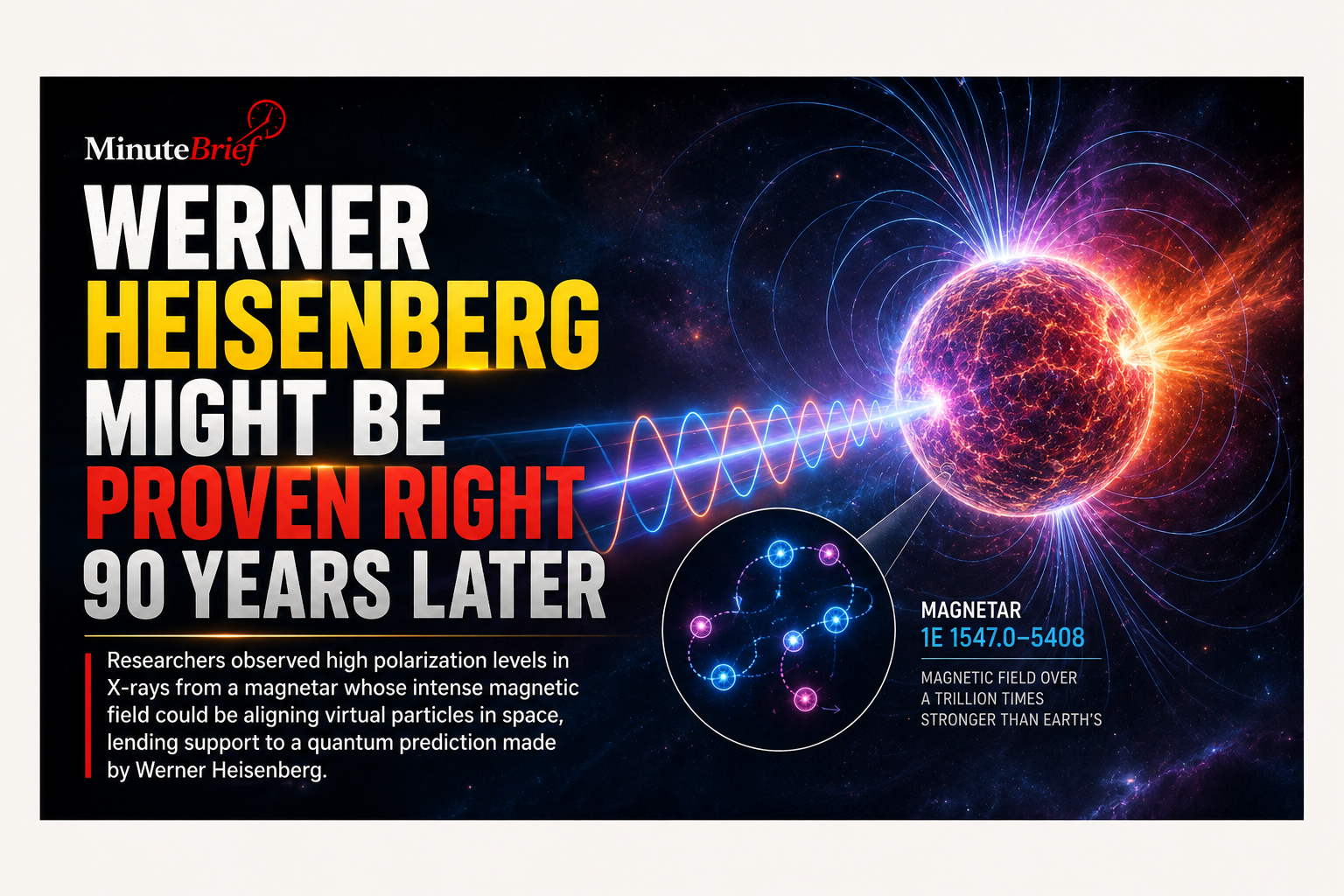
- The Theory: Quantum mechanics suggests a vacuum might actually be filled with "virtual particles" that pop in and out of existence. Physicist Werner Heisenberg predicted that a powerful enough magnetic field could align these particles and alter light passing through—an effect called vacuum birefringence.
- The Clue: Researchers studied the magnetar 1E 1547.0-5408, a neutron star with magnetic fields over a trillion times stronger than Earth's. High polarization levels in its X-rays suggest the magnetic field may be aligning virtual particles to bend light.
- Why It's Still a "Maybe": Scientists caution that other physical processes around the star could potentially mimic this signal. More advanced simulations are required to confirm whether this is a true quantum detection.
Source: Science Daily