In Brief:
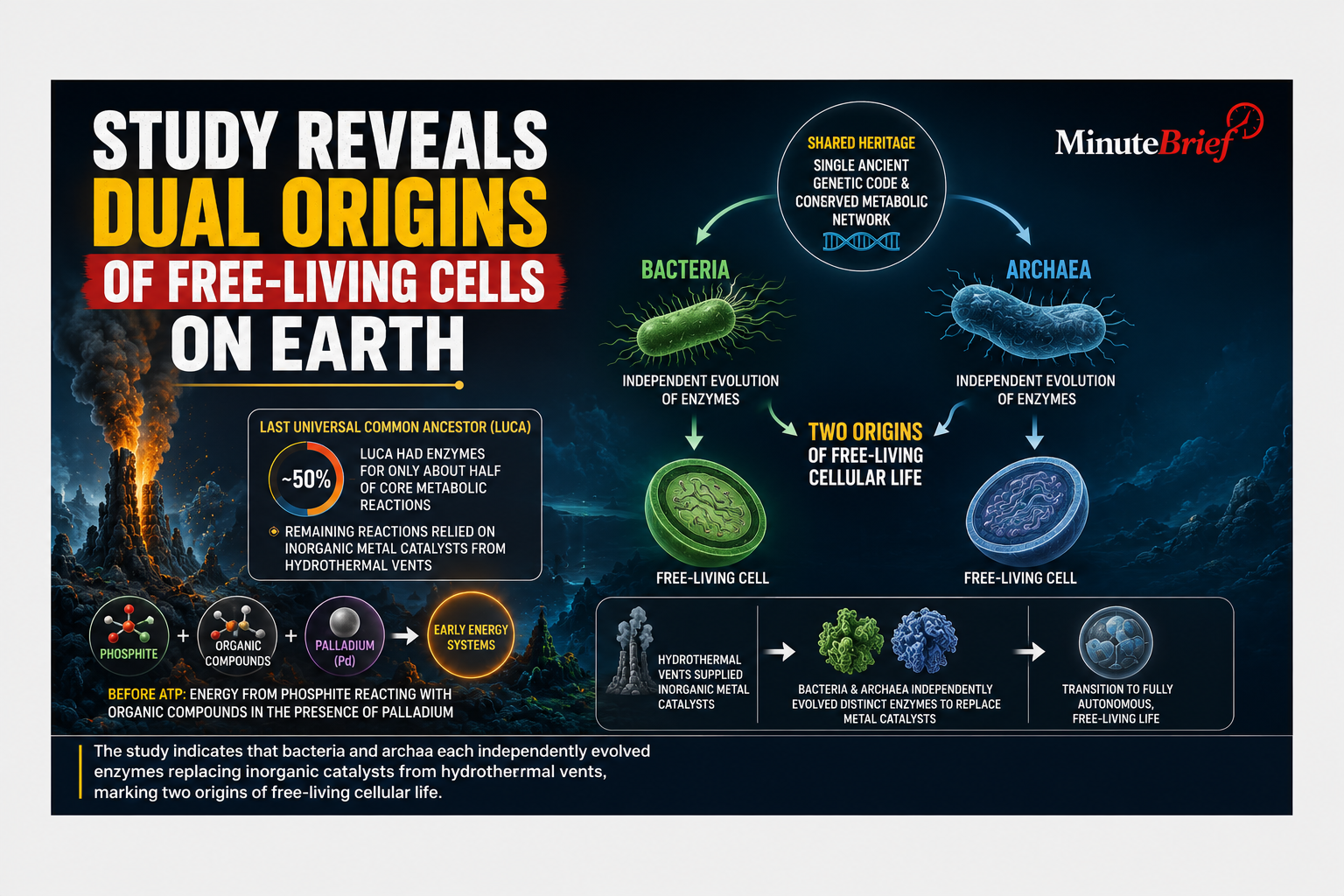
- Two Origins: Bacteria and archaea independently evolved into free-living cells.
- LUCA's metabolism used biological enzymes for half its reactions and vent metals for the rest.
- Hydrothermal phosphite and palladium provided energy before ATP systems existed.
- Both lineages developed distinct enzymes to replace metal catalysts and leave vents.
Based on the study published in Science Advances by an international team led by Heinrich Heine University Düsseldorf, researchers analyzed a network of 420 primordial metabolic reactions and found evidence that free-living cells emerged independently twice on Earth.
While all life shares a single ancient genetic code and a conserved metabolic network, the last universal common ancestor (LUCA) possessed biological enzymes for only about half of these core metabolic reactions; the remaining reactions relied on inorganic metal catalysts supplied by hydrothermal vent environments.
Before modern ATP-based energy systems evolved, reactions were powered by naturally occurring phosphite reacting with organic compounds in the presence of palladium. As bacteria and archaea diverged, each lineage independently evolved structurally distinct enzymes to replace these environmental metal catalysts, allowing both groups to separately transition from vent-dependent chemical processes into fully autonomous, free-living cellular life.
Source: Science Daily