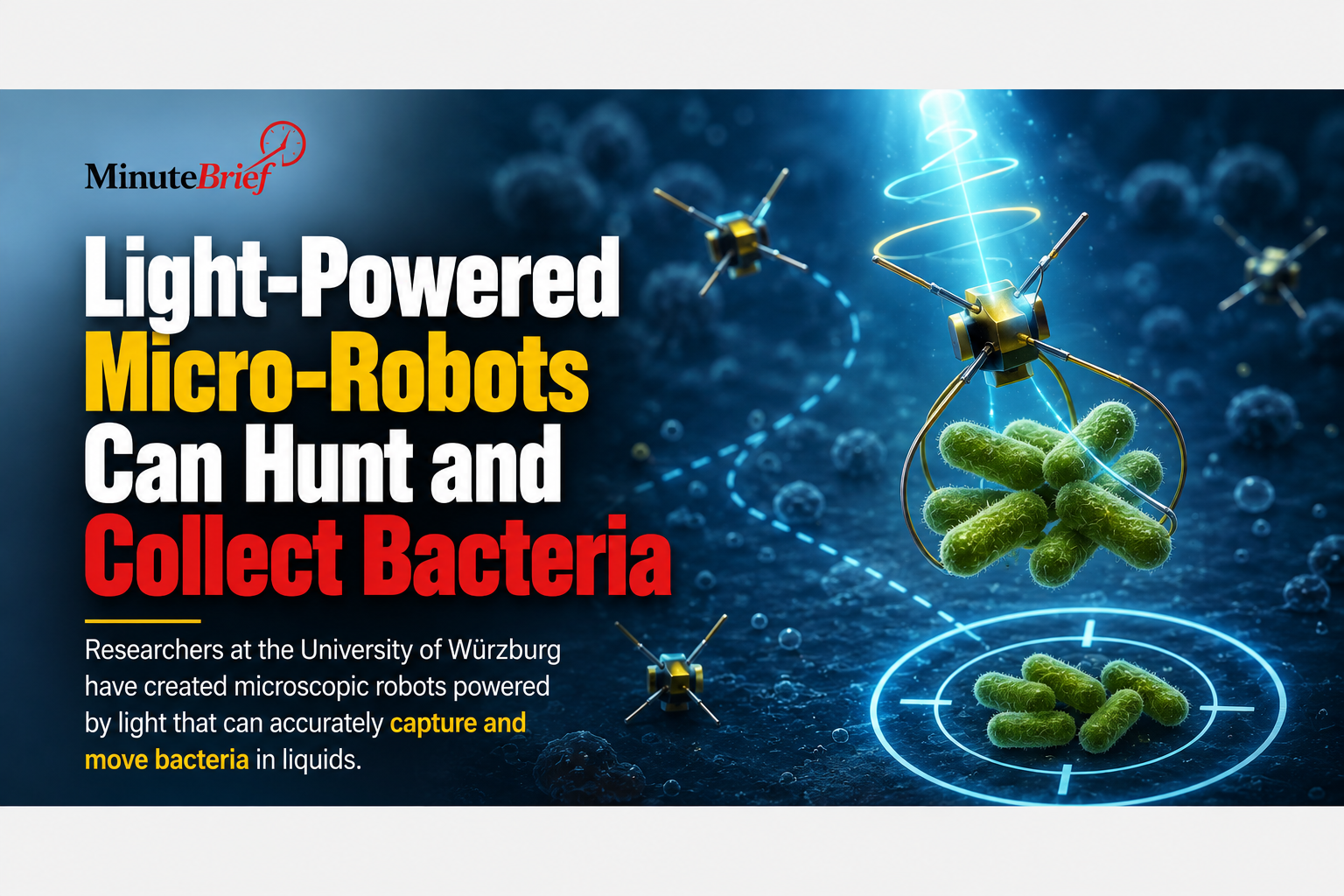
Scientists have developed microscopic, light-driven robots capable of gathering and relocating bacteria in liquids. Measuring roughly 50 times smaller than the width of a human hair, these tiny "cleaning crews" mark a major step in direct cell manipulation.
Key Highlights
- Light-Powered Propulsion: Developed by researchers at the University of Würzburg, the nanorobots use built-in nanoantennas that absorb and re-emit light. The resulting photon recoil drives the micro-drones forward.
- Precision Steering: By rotating the incoming light's polarization, scientists can align the robot's antenna wires to instantly change its direction, enabling sharp 90 degree turns.
- Microscopic Cleaners: In lab tests, the robots successfully hunted down, gathered, and deposited clusters of bacteria at designated target locations while remaining highly maneuverable.
Looking Ahead
This ability to actively capture and transport microbes opens up promising possibilities for future biomedical research, microbiology, and precision healthcare at the microscopic scale.
Source: Science Daily