In Brief
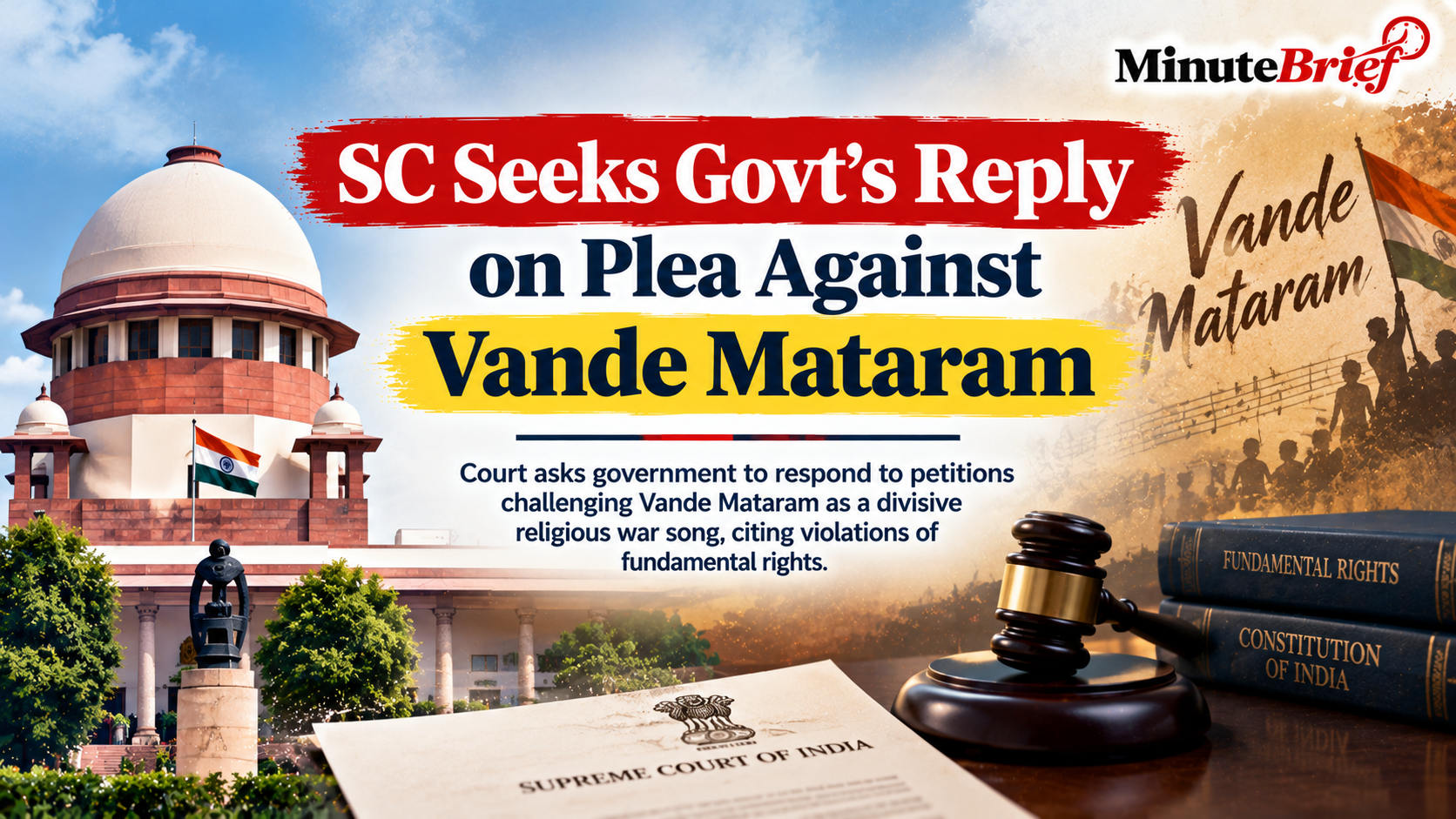
- A three-judge bench led by Chief Justice Surya Kant issued notice to the Union Government to respond to petitions challenging orders enforcing the full six-stanza rendition of the National Song.
- Petitions filed by Carnatic vocalist T.M. Krishna, former bureaucrat B.D. Borkar, and activists contend that penalizing non-singing violates freedom of speech, expression, and religious conscience.
- Petitioners argue that while the first two non-religious stanzas were adopted by the Constituent Assembly, the remaining stanzas carry distinct religious imagery that compromises secular principles.
- The top court tagged the fresh petitions along with earlier pending pleas and scheduled the consolidated matter for hearing on November 30, 2026.
Petitions Challenge Mandatory Recitation and Penalties
The Supreme Court of India expanded its scrutiny over recent government directives mandating the recitation of all six stanzas of Vande Mataram.
The bench—comprising Chief Justice Surya Kant, Justice Joymalya Bagchi, and Justice V. Mohana—sought an official response from the Union Ministry of Home Affairs regarding executive orders issued on January 28 and July 9, 2026, as well as recent statutory amendments expanding the Prevention of Insults to National Honour Act.
The legal challenges, spearheaded by Carnatic vocalist T.M. Krishna and former IAS officer B.D. Borkar, contend that enforcing the later stanzas of the song and introducing penal consequences for non-compliance infringes upon fundamental rights guaranteed under Articles 19(1)(a) (Freedom of Speech) and 25 (Freedom of Conscience and Religion).
Debate Over Constituent Assembly Mandate and Judicial Precedent
During preliminary arguments, senior counsels representing the petitioners highlighted that the Constituent Assembly in 1950 granted official status specifically to the first two stanzas of Vande Mataram to maintain secular inclusivity.
The petitioners argued that enforcing all six stanzas—which contain explicit devotional imagery and references originally published in Bankim Chandra Chattopadhyay's novel Anandamath—compels individuals to participate in expressions that may conflict with their personal religious beliefs.
The arguments heavily draw upon the landmark 1986 Supreme Court judgment in Bijoe Emmanuel v. State of Kerala, which established that standing respectfully in silence without being forced to sing a song or anthem satisfies national honor without violating personal freedom of conscience.
The Supreme Court has directed the Union Government to file its counter-affidavit before the next scheduled hearing on November 30, 2026.