In Brief:
- Imagery reveals evidence of recently flowing liquid nitrogen on Pluto.
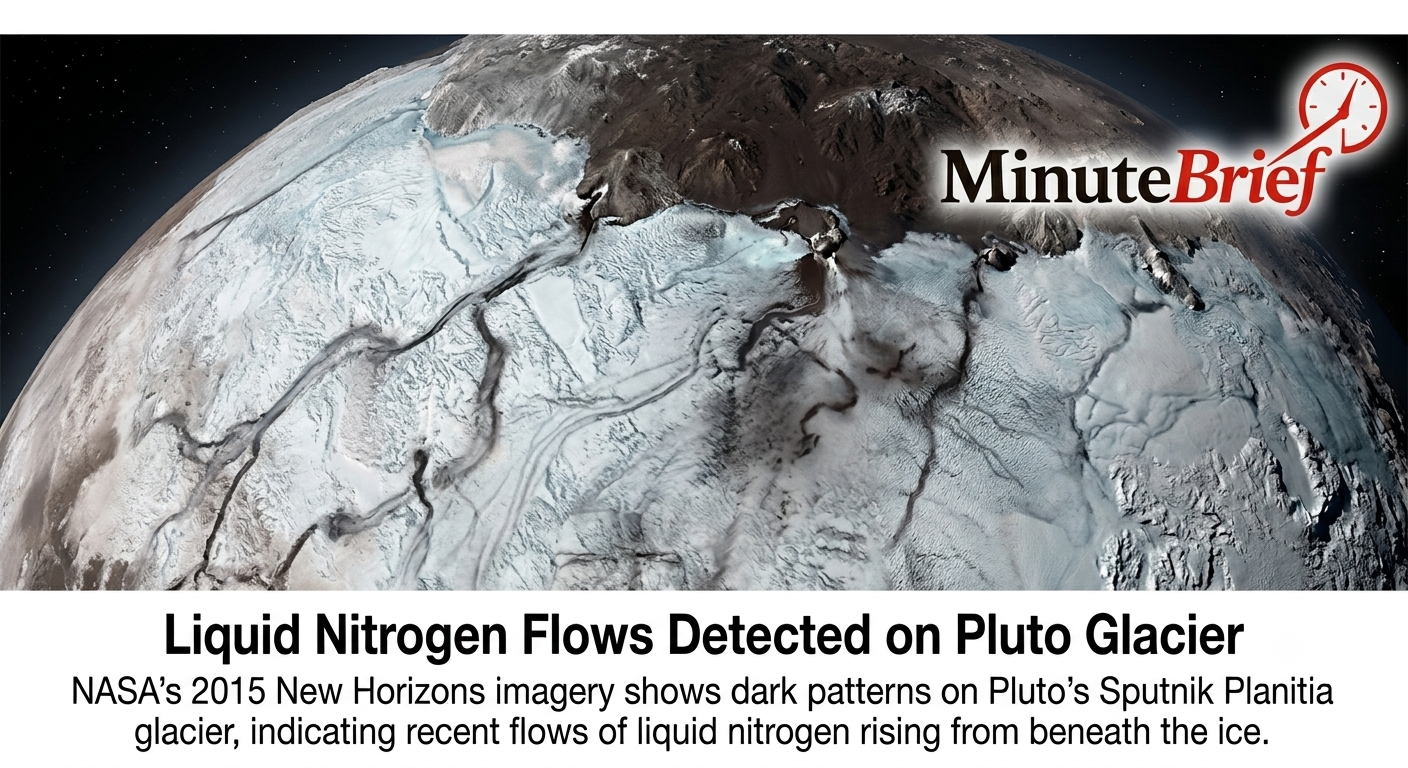
- Dark patterns appear at the edge of Sputnik Planitia, a giant frozen glacier.
- Liquid rises from underneath the glacier due to Pluto's cold, rain-free atmosphere.
- Marks a unique, time-variable geological feature on the dwarf planet.
A recent analysis of imagery from NASA’s 2015 New Horizons mission reveals evidence of recently flowing liquid nitrogen on Pluto's surface. Dark linear and diffuse patterns found along the northern edge of Sputnik Planitia—a massive frozen nitrogen glacier—closely resemble Earth's glaciated terrain wetted by subsurface liquid emergence.
Because Pluto’s atmospheric and thermal conditions rule out liquid nitrogen rain, scientists conclude that liquid nitrogen is rising from underneath the glacier via a "basal melting" process, introducing a new type of time-variable geological feature on the dwarf planet.