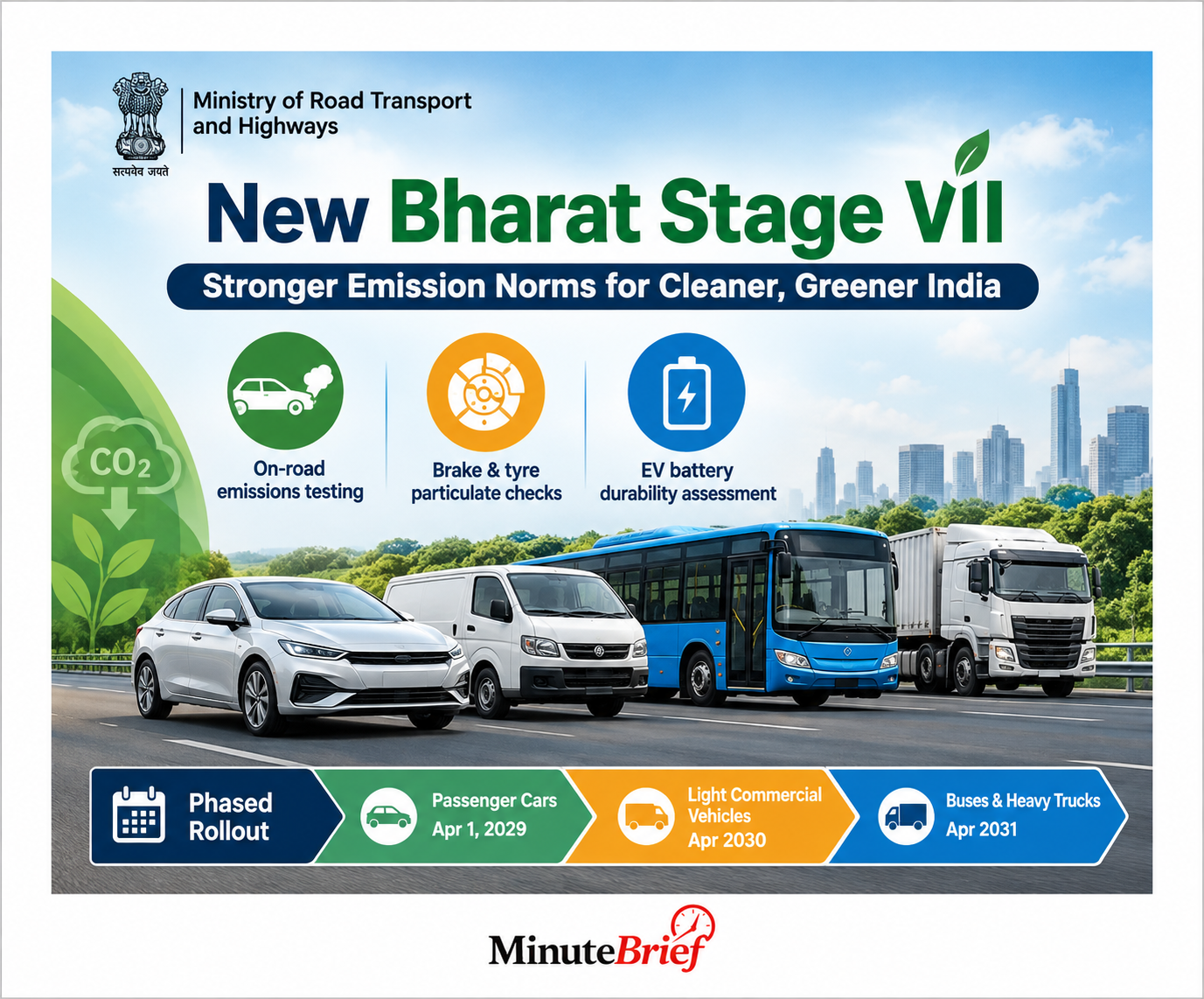
India’s Ministry of Road Transport and Highways has proposed new Bharat Stage VII (BS-VII) vehicle emission standards to strengthen vehicular pollution controls and expand testing beyond conventional exhaust emissions. The draft rules propose on-road emissions testing under more realistic driving conditions, alongside checks on particulate pollution from brake wear and tyre abrasion.
They also seek to assess the long-term durability of electric-vehicle batteries, broadening the scope of vehicle regulation. The proposed standards would be implemented in phases, beginning with passenger cars from April 1, 2029, followed by light commercial vehicles from April 2030, and buses and heavy trucks from April 2031. The phased rollout is intended to give manufacturers and regulatory authorities time to prepare for the new requirements.
Published in October 2026, the draft notifications invite public comments for 30 days from the date the copies are made available to the public. The proposals may be revised before finalisation. Once implemented, the BS-VII framework would expand India’s approach to vehicle pollution control by addressing emissions from exhausts, brakes and tyres, while introducing additional requirements for electric-vehicle battery durability.