For decades, scientists believed human intelligence was purely a numbers game: our brains are special because 100 billion neurons link together in a massive network, with each cell acting like a simple on-off switch.
A new study published in Proceedings of the National Academy of Sciences (PNAS) flips that assumption.
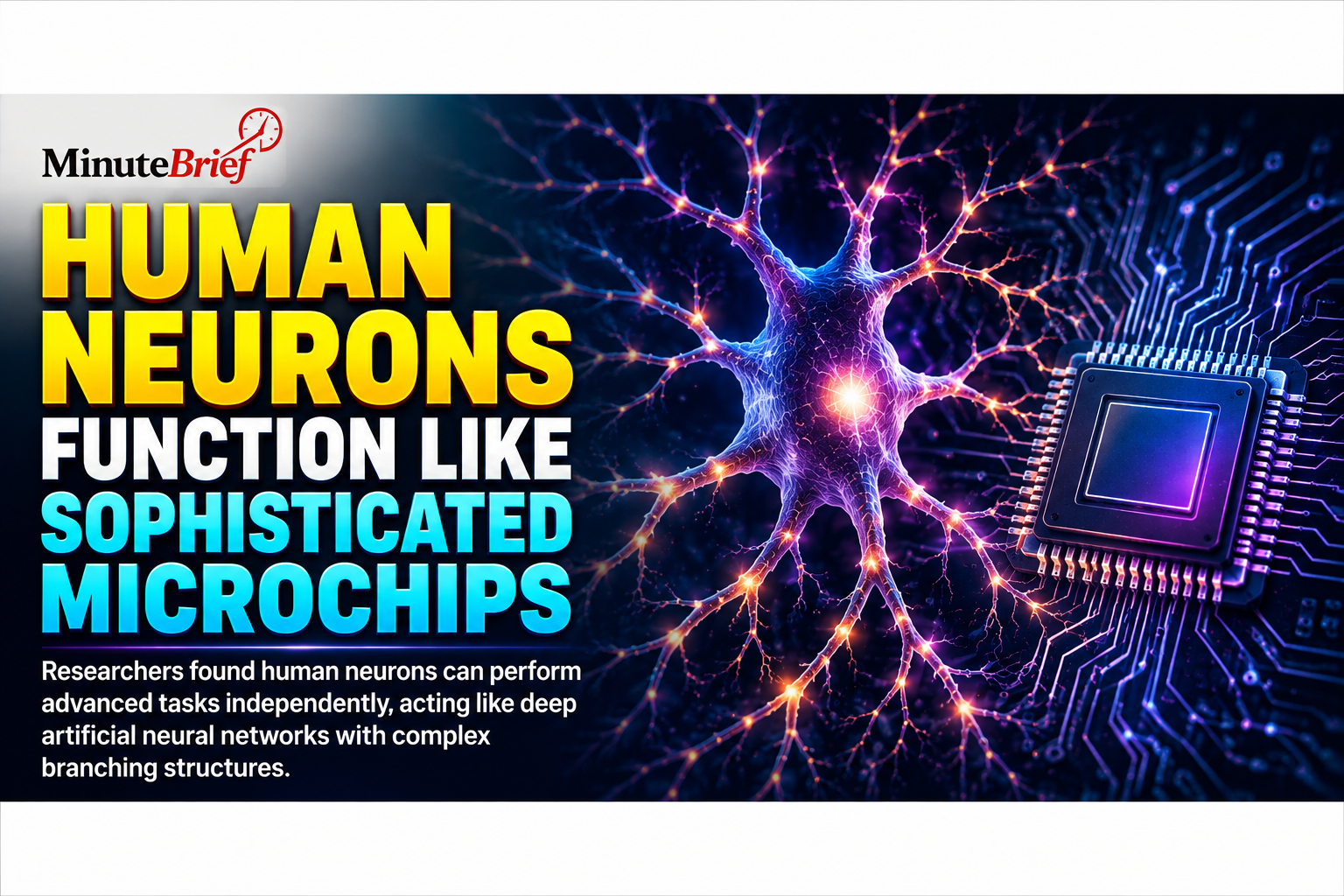
Researchers from The Hebrew University of Jerusalem and the Free University of Amsterdam discovered that individual human neurons function like sophisticated microchips or deep artificial neural networks.
Key Discoveries
- AI-Tested Complexity: The team built artificial neural networks to clone the input-output behavior of real brain cells. Replicating a single human neuron required surprisingly complex artificial networks.
- Built-in Power: Thanks to branching dendritic trees and unique electrical properties, a single cell can perform advanced tasks independently, such as distinguishing between different visual images.
- Rethinking Cognition: High-level human traits like language, math, and reasoning don't just rely on total brain size, but on the processing capacity of individual cells.
- Smarter AI: These insights offer a roadmap to design next-generation AI using computationally deep, brain-inspired artificial units.
Source: Science Daily