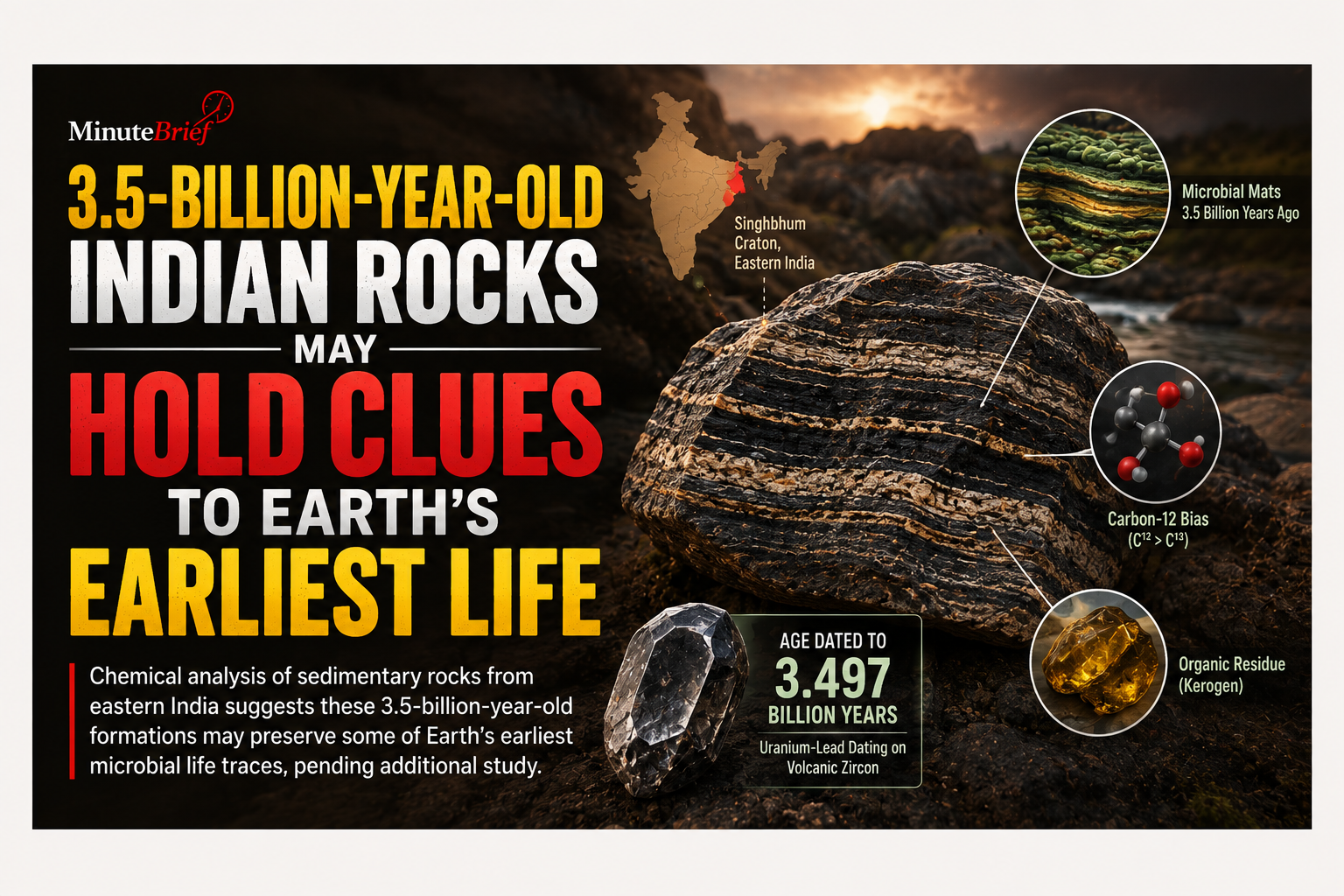
A research team studying 3.5-billion-year-old rocks in eastern India has uncovered potential chemical traces of ancient microbial life—a discovery that could represent the oldest directly dated rock with a confirmed biological footprint.
A Discovery Hidden in Stone
In a study published in PNAS, scientists examined a carbon-rich, layered rock called chert from the Singhbhum Craton. The rock features paper-thin, alternating layers of silica and organic matter, closely matching the physical patterns created by ancient microbial mats (dense sheets of primitive bacteria and archaea). Uranium-lead dating on nearby volcanic zircon crystals pinpointed the rock's age to roughly 3.497 billion years old.
Why Scientists Think It Might Be Biological
Distinguishing ancient biological remains from standard geological formations is challenging, but several key indicators point toward early life:
- Carbon-12 Bias: Isotope analysis showed a higher ratio of carbon-12 over carbon-13, a signature typical of biological carbon-fixing processes.
- Organic Residue: Spectroscopy confirmed the presence of kerogen—a waxy organic mixture derived from ancient biological matter.
What Still Needs Verification
Non-biological processes can sometimes mimic biological signatures. To confirm this finding, future independent research will need to verify whether the zircons match the exact timing of sediment deposition and rule out potential chemical changes caused by later heat or fluid exposure.
Source: Phys.org