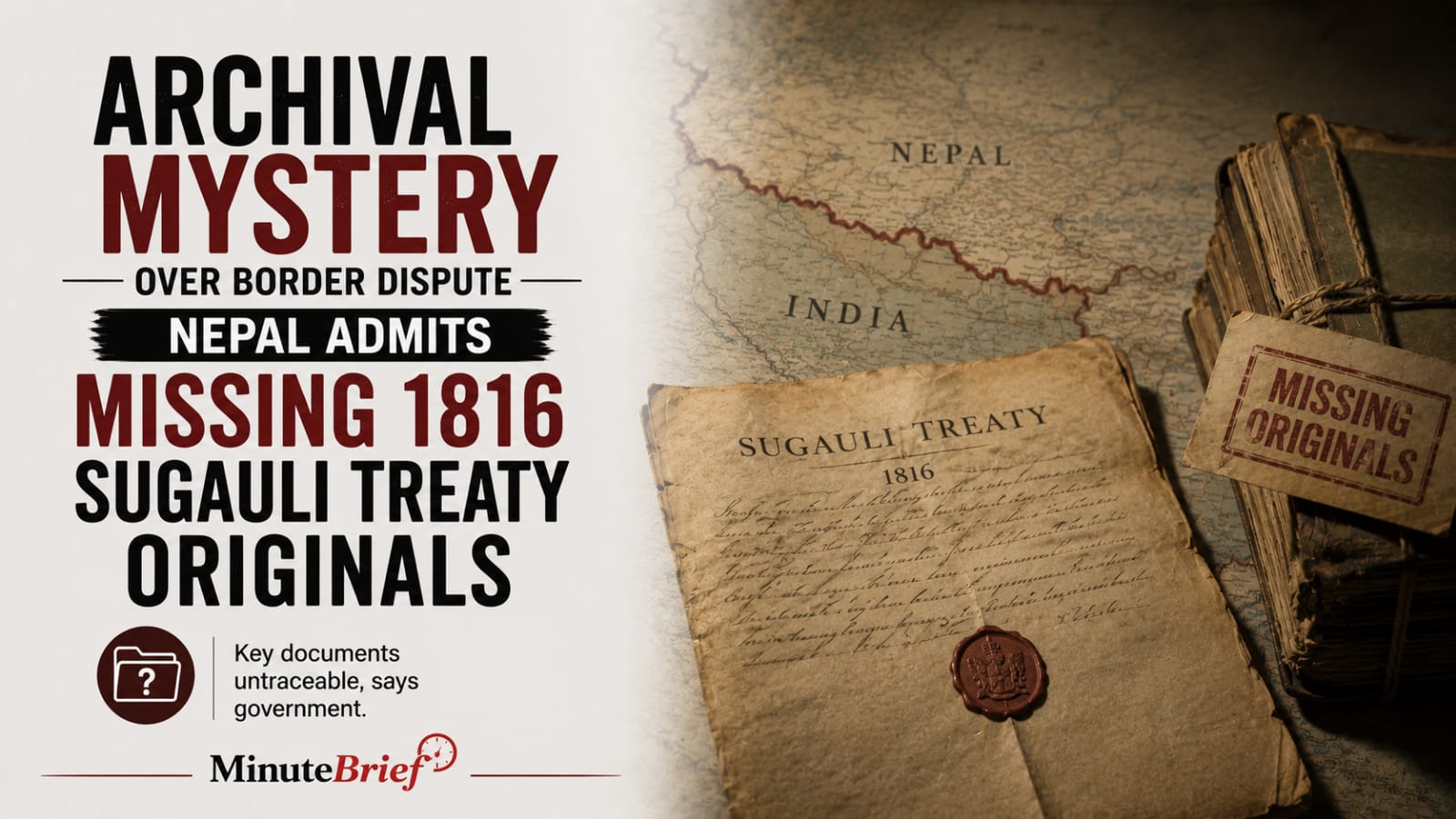
In a major diplomatic disclosure, Nepal’s Ministry of Foreign Affairs has acknowledged to Parliament that the government cannot confirm whether it possesses the official, original signed copy of the 1816 Sugauli Treaty. Responding to queries in the House of Representatives, Foreign Minister Shisir Khanal stated that while various treaty-related records are housed in the National Archives, officials cannot establish if any are authentic original documents.
The admission follows an extensive investigation by a committee of Nepal’s National Assembly, which searched government archives, museums, and ministries but failed to locate the original signed copies of either the 1816 Sugauli Treaty or the 1950 Treaty of Peace and Friendship with India. The 210-year-old pact serves as the primary historical and legal basis for defining Nepal’s territorial boundaries with India, making the missing documents a significant revelation amid ongoing diplomatic tension.
The border dispute hinges on contrasting geographical interpretations of Article 5 of the treaty, which designated the Kali (Mahakali) River as Nepal's western boundary—leading Kathmandu to claim Limpiyadhura, Lipulekh, and Kalapani. However, New Delhi maintains that the river's source lies near Kalapani, making the region an integral part of Uttarakhand's Pithoragarh district, and has reiterated that all territorial issues must be addressed bilaterally based on historical facts.
Source: The Times of India